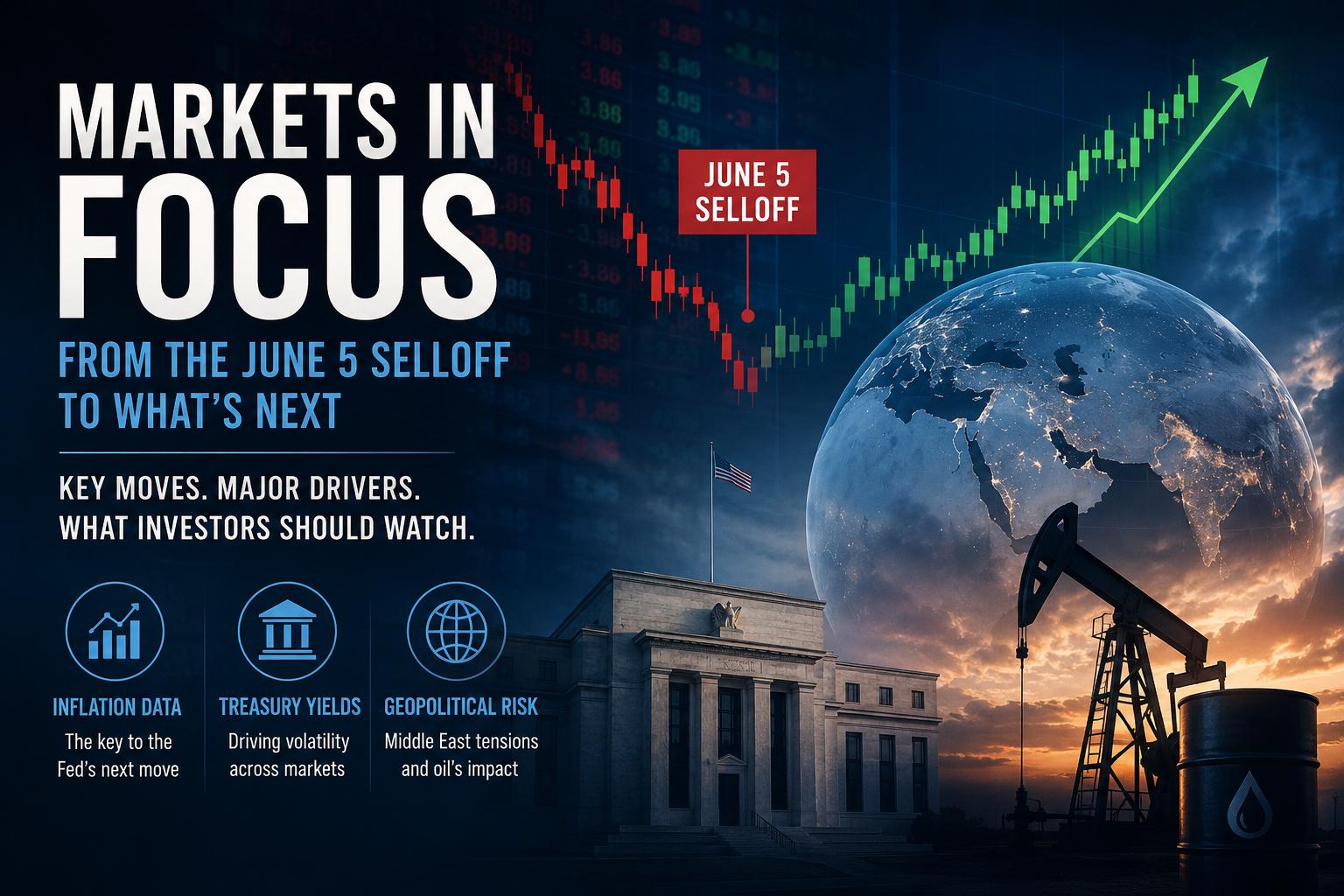
Financial Markets Recap: From the June 5 Selloff to This Week’s Crosscurrents
Financial markets entered June with significant momentum.
The S&P 500, Nasdaq, and Dow Jones Industrial Average had recently reached record highs as investors continued to pour money into artificial intelligence, technology infrastructure, and companies expected to benefit from the next wave of AI investment.
Then June 5 happened.
The June 5 Selloff: Why Stocks Suddenly Dropped
The June 5 selloff was primarily triggered by a stronger-than-expected U.S. employment report and a sharp rise in Treasury yields. Markets had been expecting a much softer labor market. Instead, job growth came in substantially above expectations, causing investors to rethink the path of Federal Reserve policy. Treasury yields surged as traders began pricing in the possibility that the Fed may need to keep interest rates higher for longer.
The result was a broad repricing of risk assets.
The technology sector absorbed the majority of the damage. High-growth AI and semiconductor stocks, which had been leading the market higher for months, suddenly faced higher discount rates as Treasury yields climbed. The Nasdaq fell roughly 4%, while semiconductor shares experienced some of their steepest declines of the year. More than $1 trillion in market value was erased during the session.
Adding to investor anxiety were renewed geopolitical concerns in the Middle East. Rising tensions between the United States and Iran pushed oil prices higher and raised concerns about future inflation pressures.
What Happened After the Selloff?
The market’s reaction after June 5 revealed an important theme that has defined much of 2026: investors still want to own growth, but they are increasingly sensitive to interest rates.
Following the initial decline, buyers stepped back into many technology names. AI enthusiasm remains powerful, supported by continued investment in data centers, semiconductors, networking equipment, and cloud infrastructure. Semiconductor stocks experienced a sharp rebound as investors viewed the pullback as an opportunity rather than the beginning of a major bear market.
However, market leadership became narrower and more selective.
Investors began distinguishing between companies with real earnings growth and those whose valuations had simply expanded because of AI excitement. Several analysts noted that portions of the AI trade had become increasingly speculative and vulnerable to sharp corrections.
Meanwhile, Treasury yields remained elevated as traders continued to assess the inflation implications of strong economic growth and higher energy prices. Bond markets have become the primary driver of short-term equity volatility.
Oil Returns to Center Stage
Another major story since June 5 has been the renewed focus on energy markets.
The Strait of Hormuz remains one of the most important chokepoints in global energy markets. Any disruption to shipping through the region has immediate implications for oil prices and inflation expectations. Renewed military activity between the United States and Iran has pushed crude oil prices higher and forced investors to reconsider the inflation outlook for the second half of the year.
Higher oil prices create a difficult challenge for policymakers. Energy costs can quickly feed into transportation, manufacturing, and consumer prices, making it harder for inflation to move lower.
That is one reason bond investors have become increasingly cautious.
What Markets Are Watching Now
As we move through the remainder of the week, three themes are likely to dominate trading.
1. Inflation Data
Inflation remains the single most important economic variable for financial markets.
If inflation readings come in hotter than expected, Treasury yields could continue rising, creating additional pressure on technology and growth stocks. If inflation shows signs of moderating, investors may regain confidence that the Federal Reserve can remain on hold.
2. Treasury Yields
The bond market is currently setting the tone for virtually every major asset class.
A sustained move higher in the 10-year Treasury yield would likely pressure equities, particularly high-valuation technology names. Conversely, stable or declining yields could provide support for another rally attempt.
3. Middle East Developments
Geopolitical developments remain a wildcard.
Markets have shown an ability to absorb a surprising amount of geopolitical uncertainty during 2026. However, any escalation that threatens global energy supplies could quickly change investor sentiment and drive another round of volatility across stocks, bonds, and commodities.
Bottom Line
The June 5 selloff served as a reminder that even powerful bull markets can be vulnerable when interest rates rise unexpectedly.
Strong economic growth remains supportive for corporate earnings, but that same strength is keeping inflation concerns alive and preventing bond yields from moving lower. Investors now find themselves balancing three competing forces: continued AI-driven growth, persistent inflation risks, and ongoing geopolitical uncertainty.
For the remainder of the week, expect markets to take their cues from inflation data, Treasury yields, and developments in the Middle East. The next major move in stocks may ultimately depend less on earnings and more on what happens in the bond market.
Sources
- U.S. Bureau of Labor Statistics (BLS)
- Employment Situation Report, June 2026
- https://www.bls.gov
- U.S. Department of the Treasury
- Daily Treasury Yield Curve Rates
- https://home.treasury.gov
- Federal Reserve Bank of St. Louis (FRED)
- Treasury Yield Data and Economic Indicators
- https://fred.stlouisfed.org
- Reuters
- Coverage of U.S.-Iran tensions, oil markets, and global financial markets
- https://www.reuters.com
- The Wall Street Journal
- Market reaction to the June 5 employment report and Treasury yield movements
- https://www.wsj.com
- Axios
- Analysis of inflation expectations, Treasury yields, and equity market performance
- https://www.axios.com
- Financial News London
- Hedge fund and institutional investor commentary on AI-related market positioning
- https://www.fnlondon.com
- The Guardian
- Semiconductor sector rebound and technology market developments
- https://www.theguardian.com/business
- CME Group
- Interest Rate Futures and Fed Funds Market Expectations
- https://www.cmegroup.com
- U.S. Energy Information Administration (EIA)
- Crude Oil Market Data and Energy Market Analysis
- https://www.eia.gov
- Institute for Supply Management (ISM)
- Services PMI and Economic Activity Indicators
- https://www.ismworld.org
- ADP Research Institute
- National Employment Report
- https://www.adpemploymentreport.com
(Visit Fin Pro Marketing – The Best Marketing for Finance Professionals)


Billy Lee, CEO of Great White Financial, is a sportsman, businessman, artist, speaker, writer, and producer.
Billy is the Founder of the Wellness Institute for Economic Growth and Kairos Athletics.