
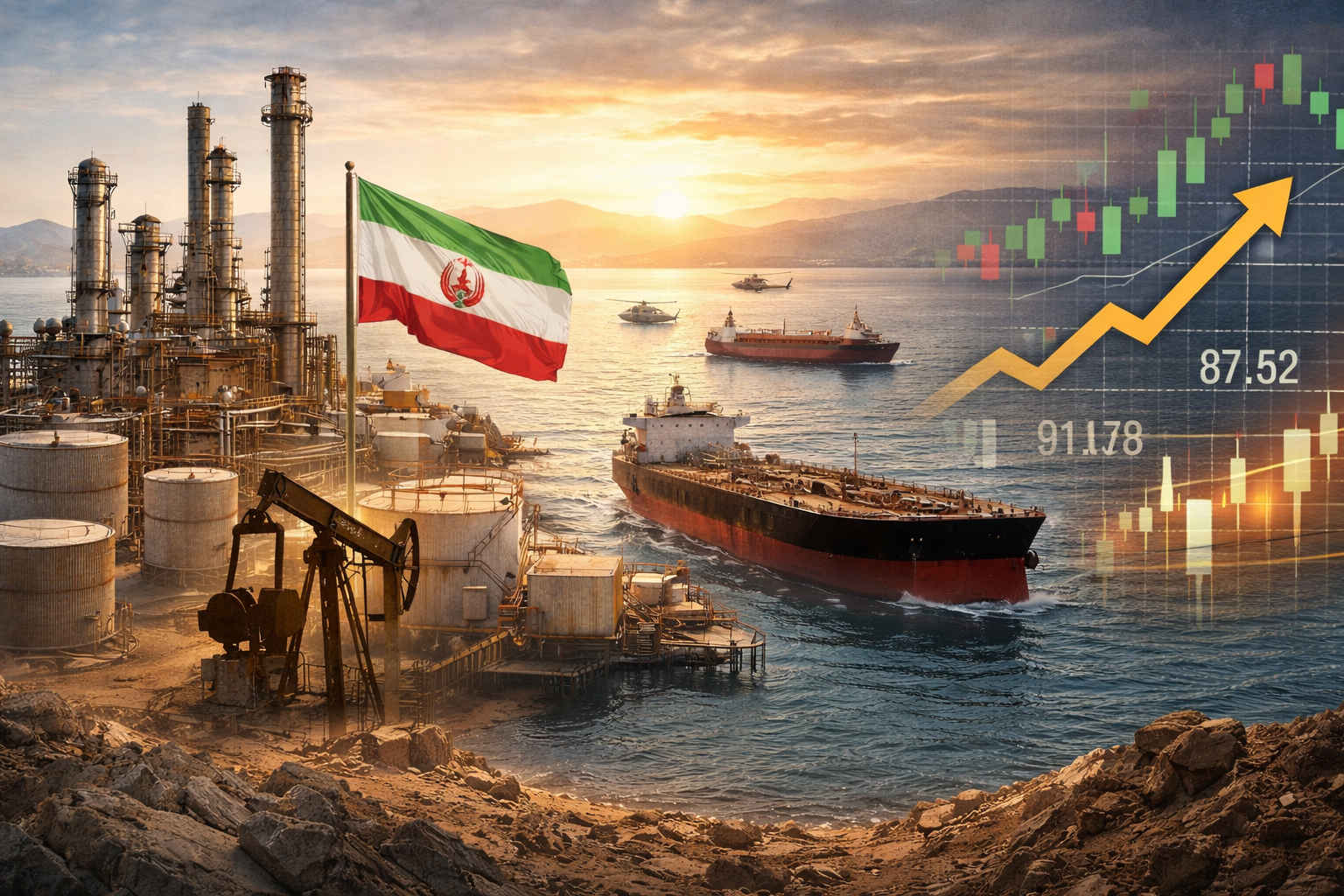
What Many Commentators Are Missing About the Iran Oil Situation
Much of the public discussion surrounding the current Iran crisis assumes a familiar outcome: geopolitical tension automatically leads to a major oil price spike. This narrative fits the traditional supply-shock model many commentators rely on for clicks. But, a closer look at how modern oil markets actually function suggests several important realities are being overlooked.
Many structural factors explain why markets react very differently than prevailing commentary suggests.
Remember: Iranian Oil Already Operates Partly Outside the Transparent Market
One of the most misunderstood features of the Iranian oil trade is that a large share of its crude does not flow through the fully transparent global market that determines benchmark prices like Brent and WTI.
Because of sanctions, much of Iran’s crude moves through opaque channels, including ship-to-ship transfers, disguised cargoes, and discounted bilateral arrangements. China is the dominant buyer of these barrels, absorbing them through smaller “teapot” refiners.
This means a significant portion of Iranian supply is already operating outside the most visible price-forming system. As a result, disruptions to these flows do not always translate into the dramatic price reactions that traditional models predict.
In other words, part of the market has already adjusted to Iranian supply functioning in a semi-detached trading system.
The Real Question Is the Condition of Iran’s Energy Infrastructure
While headlines often focus on political escalation, energy markets concentrate on the condition of the physical infrastructure that actually moves oil.
Iran’s energy system is built around several critical components:
• major producing fields in Khuzestan
• large refining complexes such as Abadan and Bandar Abbas
• pipeline networks connecting fields to export terminals
• offshore and island export hubs such as Kharg, Lavan, and Sirri
• alternative export routes such as the Jask terminal connected to a 1,000-km pipeline designed to bypass the Strait of Hormuz
These facilities collectively enable Iran to produce roughly 3.3 million barrels of oil per day, representing about 4.5% of global supply.
The key point for markets is simple: oil wells themselves are widely dispersed and difficult to eliminate, but processing plants, pipelines, and export terminals are the true bottlenecks of the system.
If those nodes remain operational, global supply may remain largely intact even during significant geopolitical tension.
Traders Watch Data, Not Narratives
Professional energy traders track a very specific set of indicators during geopolitical crises. These include:
• export loading rates at major terminals
• satellite tracking of tanker traffic
• shipping insurance premiums in the Strait of Hormuz
• Chinese refinery import activity
• OPEC spare production capacity
These metrics provide real-time insight into whether physical supply is actually changing.
Until those indicators show disruption, traders are often reluctant to price in extreme geopolitical scenarios.
The Market Signal Is Often Much Simpler
Despite the complexity of political analysis, markets frequently reduce the situation to a very straightforward question:
Are barrels still flowing?
If export infrastructure continues operating and tankers continue leaving port, the immediate supply picture may remain stable. That simple reality can explain why market reactions sometimes appear muted compared with the intensity of political commentary.
Geopolitical narratives often focus on what might happen next.
Markets, by contrast, are focused on what is happening right now in the physical flow of oil.
The Distinction
None of this means geopolitical risk is irrelevant. If pipelines, refineries, or export terminals were significantly damaged, oil markets would respond quickly and dramatically.
But until the physical mechanisms of supply are disrupted, professional traders will continue to focus less on political rhetoric and more on measurable flows.
Intact infrastructure that transports energy always prevails as the greatest concern.
Sources
U.S. Energy Information Administration (EIA) – Iran Country Analysis Brief
https://www.eia.gov/international/analysis/country/IRN
International Energy Agency (IEA) – Oil Market Report
https://www.iea.org/reports/oil-market-report
Reuters – Overview of Iran’s Energy Industry and Export Infrastructure
https://www.reuters.com
S&P Global Commodity Insights – Analysis of Iranian Oil Infrastructure and Global Supply Risk
https://www.spglobal.com/commodityinsights
This material has been distributed for informational purposes only and should not be considered as investment advice or a recommendation of any particular security, strategy or investment product. Information contained herein has been obtained from sources believed to be reliable, but not guaranteed. No part of this material may be reproduced in any form, or referred to in any other publication, without express written permission. ©2026 MIXED MARKET ARTIST
(Visit Fin Pro Marketing – The Best Marketing for Finance Professionals)


Billy Lee, CEO of Great White Financial, is a sportsman, businessman, artist, speaker, writer, and producer.
Billy is the Founder of the Wellness Institute for Economic Growth and Kairos Athletics.